Section 2: Building Your Program
Establish a Family Visitation & Resource Center
Why This Module Matters
For families impacted by the child welfare system, the environment where they spend time with their children is not neutral. It either reinforces the shame and surveillance they already feel — or it actively works against it. A homelike, judgment-free space communicates something no policy document can: you are a family, not a case. The Family Visitation and Resource Center is the physical heart of the Homeward House model — as important as Parent Ally Mentors and infant mental health services — and the place where the belief that families can heal becomes something they experience.
“I am now reunified with my son and have a place to live. Homeward House provided me many resources, one of which being a place to do visits with my son until we were reunified permanently.”
— Parent
What We Know
Most supervised visitation happens in settings that were never designed with family bonding in mind — a government building, clinical setting or local fast-food restaurant where parents feel watched and children feel unsettled.
The research is consistent: families affected by substance use and poverty benefit most from support that is family-centered, attachment-informed, and delivered in a safe, nonjudgmental setting. Environment is not just backdrop. For parents and children working to maintain or rebuild their bond, the space itself functions as part of the intervention — reducing stress, supporting engagement, and creating the conditions where attachment can grow.
Five Design Principles
Homeward House is built around five design principles that translate this understanding into practice. Together they explain not just what the Center looks like, but why every element of it was chosen with intention.
Our Experience
Please view the video below for a window into what Homeward House looked and felt like for the families who came through its doors. We encourage you to watch it before reading further — and to share it widely as you build support in your own community.
What the video captures, and what seven years of experience confirmed, is that the environment does something words alone cannot.
A community partner who worked alongside families in the Center put it plainly:
“The fact that it was a house was a big thing.
You’re not in a business — you’re in a house…You can cook if you want. It doesn’t feel like your kids have been taken from you.
You can’t do that anyplace else. This normalizes what it could be like for them. This gives them incentive to better themselves.”
— Community Partner
That last part — this normalizes what it could be like for them — is worth sitting with. The Center was not just a place to visit. It was a preview of what home could look like. For parents who sometimes struggled to imagine that future, being inside it mattered.
Another community partner described the same quality from a different angle:
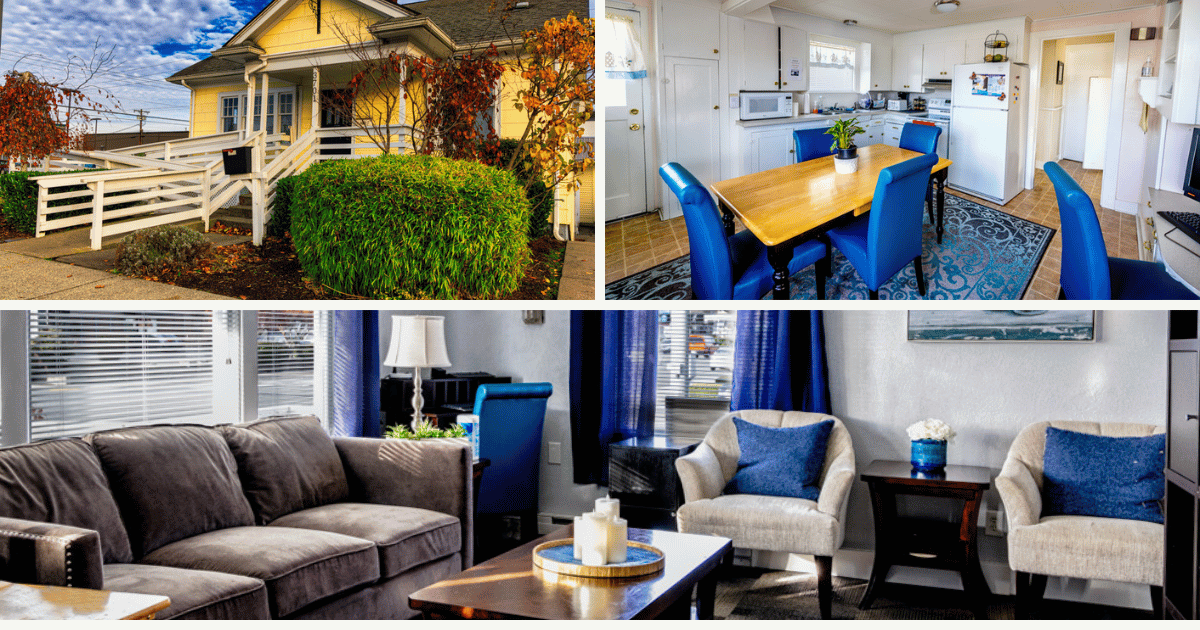
“Walking into Homeward House reminds me of going to my aunt’s house when I was a kid…homey. And that matters, because children are sponges. They absorb everything — the good and the bad.
A space like that diminishes the displacement a child is going to feel. You’d want a comfy couch, a TV, your mom or dad nearby — not an unfamiliar space with a person you barely know.
It doesn’t have to be complicated. We’re talking about a home converted into a visitation space with supportive people. That’s it. And that makes all the difference.”
— Community Partner
A Natural Fit: The Family Resource Center Designation
The Homeward House Visitation and Resource Center operated as a designated Family Resource Center — and the fit was more than administrative. Washington State law defines a Family Resource Center as “a unified single point of entry where families can obtain information, assessment of needs, referral to, or direct delivery of family services in a manner that is welcoming and strength-based.” That is, in almost every word, a description of what the Center was built to be. The designation aligned naturally with the model and opened access to state funding through the Department of Commerce and DCYF (HB 1237, 2021).
If you are building a Center in Washington, exploring FRC designation is a natural next step.
Outside Washington, many states have equivalent designations and funding pathways. Family Resource Centers are also eligible for federal Title IV-B funding. The National Family Support Network is a good first stop for understanding what’s available in your state: nationalfamilysupportnetwork.org
Parents described the experience in simpler, equally powerful terms.
“It helped me come somewhere and visit with my son when I had nowhere else to go besides McDonald’s.”
— Parent
“It’s a homelike, peaceful, and quiet environment where you can even shower and do your laundry while you are doing visitation, which was wonderful since I was homeless at the time.”
— Parent
“I really like the amount of respect I feel like I received, and I was left to be with my children and not feel like somebody was trying to hover over me or watch everything I did.”
— Parent
“It was so kid-friendly, and my kids and I were able to bond in a safe and comfortable environment.”
— Parent
What’s Next?
Before you begin planning a space, take some time to reflect — individually, and then together with your team and any parents or community members you can bring into the conversation.
Prompts for Reflection
- Which opportunities stand out most as we think about what this could look like here?
- How did the space communicate safety, dignity, and welcome — and what would that look and feel like in our community?
- What everyday family moments could our space support, even at the start?How could our space strengthen the parent-child connection?
- What practical barriers can we help remove — and which of those can we address right now?
- How could our space serve the broader community, not just program families?
- What can we begin now? What can come later?
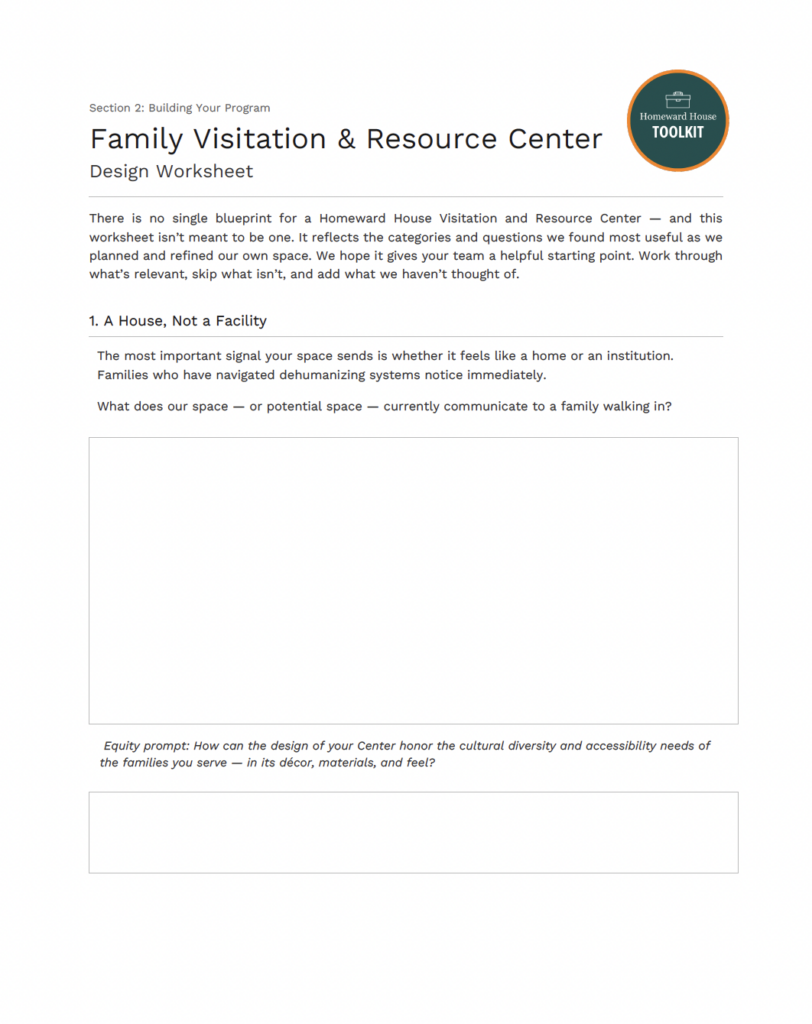
There is no single blueprint for a Homeward House Visitation and Resource Center. Communities have started with a single room and built from there. What matters is beginning with a clear intention: to create a space that treats every family with the dignity they deserve — and that makes room for the ordinary moments that make reunification possible. To help move from reflection to planning, download the Family Visitation & Resource Center Design Worksheet — a practical tool to work through with your team and, whenever possible, with parents and community members.
Pause and Reflect: Racial Equity and Social Justice
- What barriers — visible and invisible — might keep families from feeling truly welcome in the space we are creating?
- How can we ensure that families most impacted by systemic racism — particularly Black, Indigenous, and other families of color — experience this space as designed for them, not just available to them?
- How can the design of our Center honor the cultural diversity and accessibility needs of the families we serve?
Want to Know More?
The following organizations offer research and resources on the topics at the heart of this module — the importance of environment and family-centered visitation practice.
Child Welfare Information Gateway — resources on family-centered practice and supporting families affected by substance use, from the U.S. Children’s Bureau. childwelfare.gov
California Evidence-Based Clearinghouse for Child Welfare (CEBC) — a reviewed database of supervised visitation programs, with research on outcomes including attachment, reunification, and parenting. cebc4cw.org/topic/supervised-visitation
National Family Support Network — Standards of Quality for Family Strengthening and Support
Sharable Resource
Filling a Crucial Need: The Family Visitation & Resource Center — a post we shared on our website to help families, partners, and community members understand what the Center is and why it matters. Share the link with others as you build support in your own community.
Templates & Forms
Select the title or image to download. You’ll be asked for a few details first.
↓ Family Visitation & Resource Center Design Worksheet – PDF